
B2B marketing for manufacturers is the discipline of generating qualified industrial buyers through brand, content, and demand-generation programs designed for the realities of industrial sales: 6–18-month buying cycles, 6–10 stakeholder buying committees, technical credibility requirements, and trust signals (ISO certifications, named references, and plant tours) that have no analog in software B2B. Generic B2B marketing — the kind taught by HubSpot inbound courses or applied by SaaS marketers — fails when applied to manufacturing because the buyer behavior, the trust mechanics, and the sales cycle are fundamentally different.
This guide defines B2B marketing for manufacturers, explains why it diverges from other B2B disciplines, and gives you the operational framework to build a marketing program that actually works for industrial. It is built for founder-CEOs of mid-market manufacturers, marketing managers at industrial OEMs, and consultants advising manufacturing clients.
What is B2B marketing in simple terms?
B2B marketing — Business-to-Business marketing — is the function of attracting, educating, and converting other businesses into customers. Where consumer (B2C) marketing targets an individual buying for personal use, B2B marketing targets a company buying for operational, productive, or commercial use.
Manufacturing, oil and gas, mining, energy, construction, contract logistics, and industrial services are all B2B verticals. Within those, manufacturing has its own distinct characteristics that make its marketing playbook different even from other B2B disciplines.
Why does manufacturing need a specific B2B marketing playbook?
Six structural realities define manufacturing marketing:
- Long, capital-intensive sales cycles
- Multi-stakeholder buying committees
- Technical credibility is non-negotiable
- Specific trust signals matter
- Geographic concentration
- Pre-search phase dominates
A manufacturing marketing program that ignores these six realities will under-perform regardless of how good the tactics are.
How does B2B marketing for manufacturers differ from B2B marketing for SaaS?
- Sales cycle: manufacturing 6–18 months typical; SaaS 30 days to 6 months.
- Buying committee size: manufacturing 6–10 stakeholders; SaaS 3–6.
- Average deal size: manufacturing $50k–$10M (wide variance); SaaS $10k–$200k (narrower).
- Marketing-sourced pipeline target: manufacturing 30–50%; SaaS 50–70%.
- Sales motion: manufacturing field/inside hybrid; SaaS inside or self-serve.
- Trust signals: manufacturing certifications/plant tours/references; SaaS logos/reviews/free trials.
- Content depth: manufacturing technical and application-specific; SaaS use-case and ROI-focused.
- KPI focus: manufacturing pipeline value, shortlist inclusion, deal size; SaaS MRR, ARR, NRR, demo bookings.
Both disciplines are valid B2B. They are not interchangeable.
What is the purpose of B2B marketing for manufacturers?
The purpose is to build a system that generates qualified industrial buyers consistently and predictably, while compounding brand authority that makes future selling cheaper and easier.
The five outcomes a good manufacturing marketing program produces are:
- Pipeline – marketing-sourced and marketing-influenced opportunities.
- Shortlist inclusion – being on the buyer’s shortlist 18 months before they search.
- Brand authority – recognition as a credible named alternative in your category.
- Reduced selling cost – marketing-influenced deals close 30–50% faster and with less discounting.
- Talent attraction – engineering and operations talent in tight labor markets follows strong industrial brands.
Which industries rely most on manufacturing B2B marketing?
- Automotive supply chain (Tier 1, 2, 3 suppliers)
- Aerospace and defense
- Medical device contract manufacturing
- Industrial machinery and capital equipment OEMs
- Oil & gas equipment and services suppliers
- Mining equipment and services suppliers
- Energy services and equipment
- Specialty chemicals and process industries
- Packaging machinery and equipment
- Food processing equipment and ingredients
- Electronics and EMS contract manufacturers
The principles are the same; the specific channels and content adapt to the vertical.
What channels work for B2B marketing in manufacturing?
Six channels have the highest leverage for industrial B2B in 2026:
- LinkedIn thought leadership from named experts
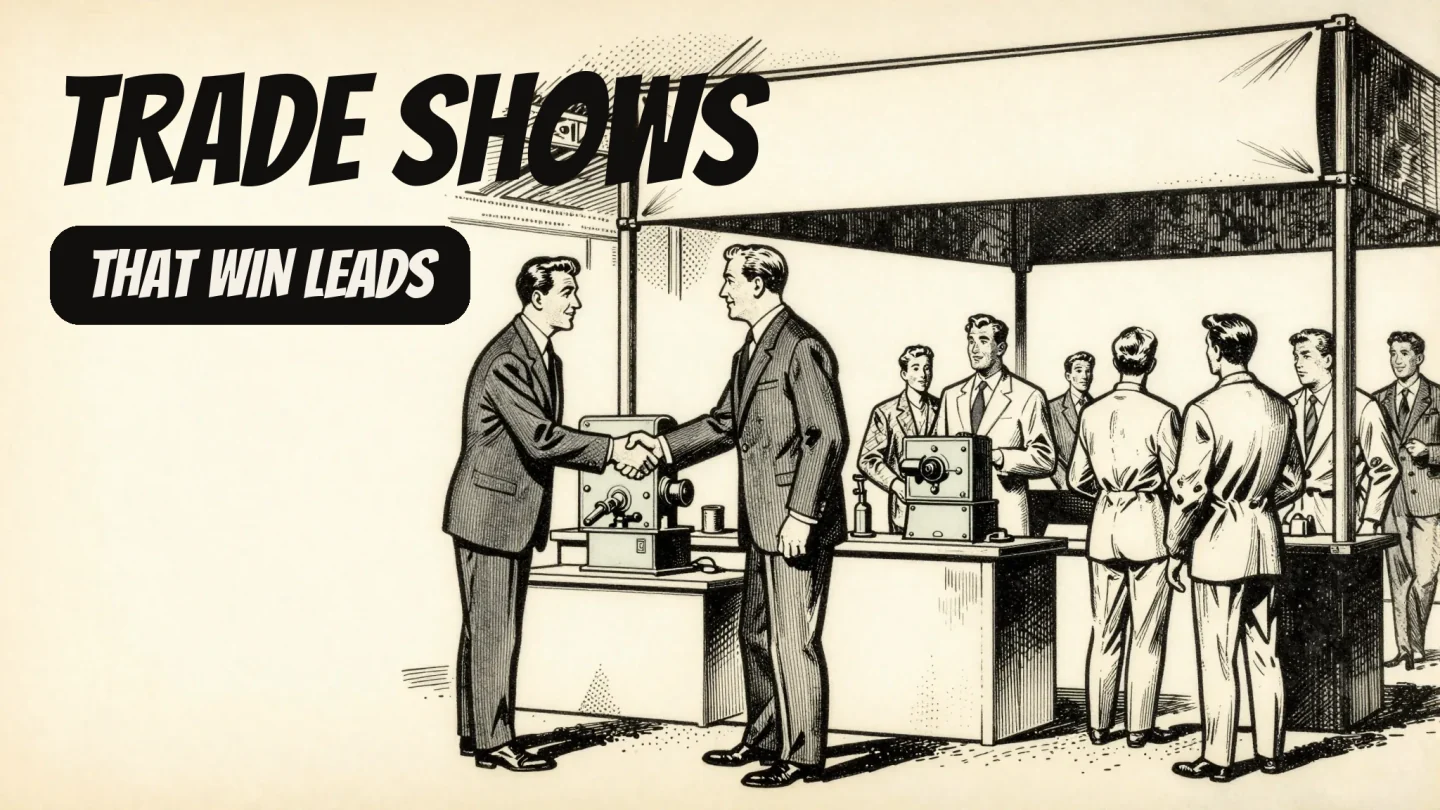
- Trade shows as named-account targeting opportunities
- Vertical-specific SEO + AI search optimization (GEO)
- Account-based marketing into 25–100 named accounts
- Technical content engine
- Industry podcasts as guest appearances
Channels that work less and less in 2026:
- Generic SEO chasing high-volume, low-intent terms
- Untargeted lead-gen forms and gated PDFs for their own sake
- Mass cold email without account or persona focus
- Traditional print advertising without digital integration and measurement
What are the biggest manufacturing marketing mistakes?
- Treating marketing as a quarterly event – industrial sales cycles are 6–18 months; sporadic campaigns cannot cover the full journey.
- Vague positioning – “we make quality components for various industries” loses to “ISO 13485-certified contract manufacturer for Class II orthopedic implants in North America”.
- Generic content – surface-level blogs that could apply to any industry fail with engineers and technical buyers.
- No named-expert presence – hiding behind a logo instead of elevating credible internal experts.
- Optimizing for wrong KPIs – lead volume is a vanity metric in industrial; pipeline and shortlist inclusion matter more.
- Trade show booth thinking – a booth alone does not convert buyers; pre-show + on-show + post-show is the real program.
- Underinvesting – most mid-market manufacturers spend under 1% of revenue; the level that produces results is typically 1.5–3%.
How is manufacturing marketing changing in 2026?
Three shifts are reshaping industrial marketing:
- AI search engines enter the buyer journey
- Named-expert effect intensifies
- Pipeline measurement becomes more sophisticated
What should a manufacturer do in the next 90 days?
Days 1–30: Define
- Write down your ICP with specifics (industry, deal size, geography, technical requirements).
- Audit current marketing assets, channels, and performance.
- Identify the internal named expert (or experts) who will be the face of your brand.
- Map your real buying committee for your top 2–3 offer types.
Days 31–60: Plan
- Build a 90-day editorial calendar for LinkedIn and technical content.
- Create a target account list (25–100 named accounts).
- Plan your trade show year and define pre-show, on-show, and post-show plays.
- Set up GEO tracking and basic analytics for website and content.
Days 61–90: Execute
- Publish 8–12 high-quality posts under named experts on LinkedIn.
- Launch ABM sequences to your top 25 accounts (email, LinkedIn, direct mail, events).
- Activate trade show pre-show outreach and meeting booking.
- Review pipeline coverage and early signals (meetings, opportunities, shortlist mentions).
After 90 days, you will know whether the playbook is fitting. After 9 months, the pipeline shape will visibly change.
Key takeaways
- B2B marketing for manufacturers is generating qualified industrial buyers through programs designed for long cycles, multi-stakeholder buying committees, and technical credibility.
- It is fundamentally different from SaaS B2B marketing.
- 80% of industrial buyers form shortlists before active search.
- Six structural realities define manufacturing marketing: long cycles, large committees, technical credibility, specific trust signals, geographic concentration, pre-search dominance.
- The six highest-leverage channels in 2026 are: named-expert LinkedIn, trade shows as ABM, vertical SEO + GEO, ABM into named accounts, technical content engine, podcast guest appearances.
- Common mistakes: quarterly thinking, vague positioning, generic content, no named experts, wrong KPIs, booth-only trade show plans, underinvestment.
- AI search and named-expert content are the two biggest 2026 shifts in industrial marketing.
- 90-day starter plan: define ICP and named expert → plan editorial and ABM → execute and measure.
If you run a manufacturing company and want help building the right B2B marketing program, request a free brand audit. 48-hour written response. No pitch, no strings.
---
About the author: Manuel García is the founder and CEO of Sell with Marketing, a B2B marketing agency for industrial brands serving DACH and international markets. With 20+ years across consumer and industrial marketing, he has worked with mining, energy, fintech, and manufacturing clients across North America, Europe, and Latin America. Tec de Monterrey faculty member.