Most industrial sales leaders look for the delay in the same places: negotiation, quoting, follow-up. It is rarely there. Most of the industrial sales cycle happens before the buyer ever talks to you, and that is exactly the part your CRM cannot see.
How do you shorten the industrial sales cycle?
You shorten the industrial sales cycle by giving the buying committee the information it needs to reach agreement without waiting on your salesperson. According to 6sense, B2B buyers in 2025 made first contact with vendors after completing 61% of their journey. The delay usually sits in the customer's internal consensus, not in your quote.
Why is the industrial sales cycle so long?
Three reasons stack on top of each other.
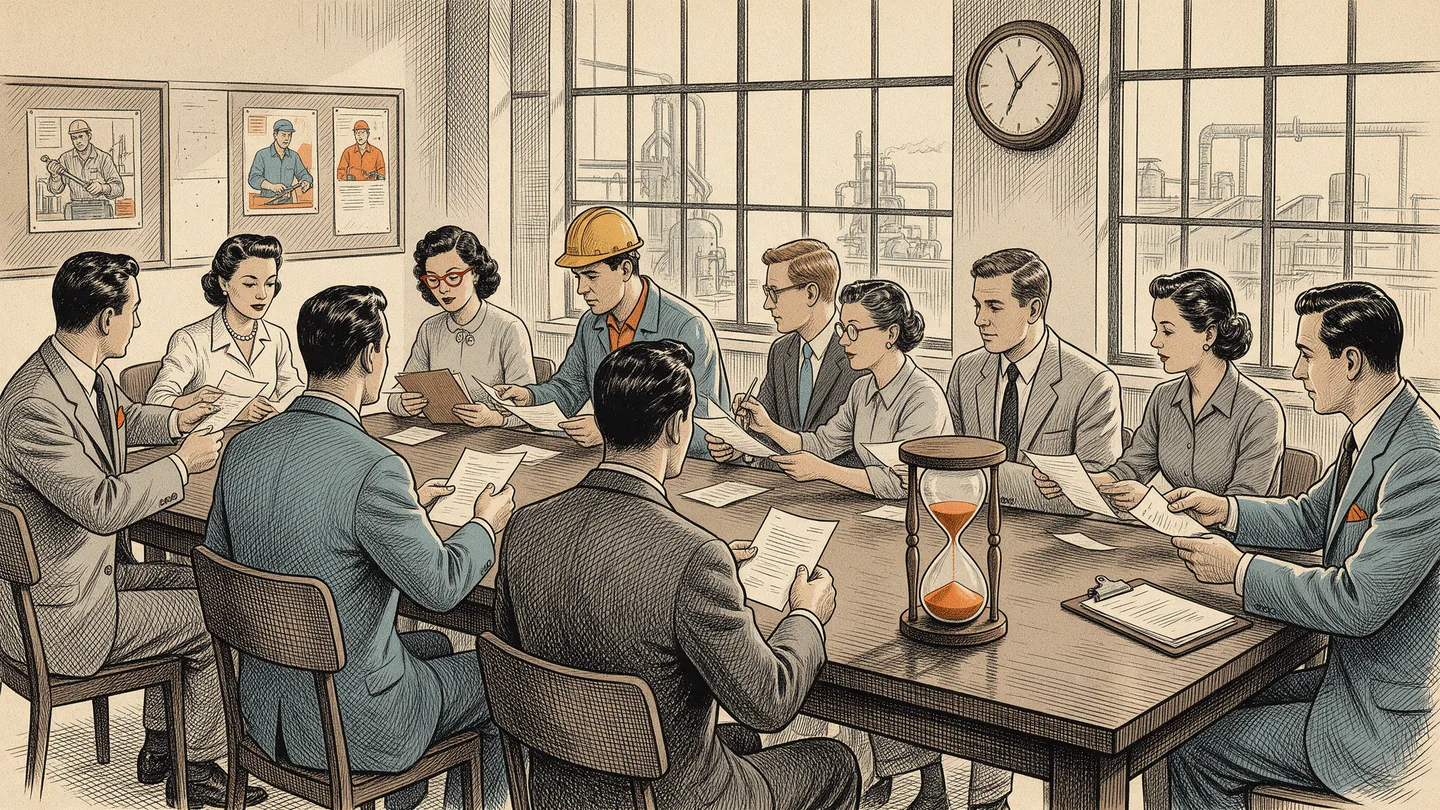
The first is the size of the decision. A production line, an automation cell or an annual supply contract is not decided by one person. Forrester counts 13 participants on average. In a typical US plant that means engineering, maintenance, operations, procurement, finance and leadership, and in multi-site companies often a corporate approver in another state or country.
The second is that each of those people researches independently. Gartner found in 2025 that 61% of B2B buyers prefer a rep-free buying experience, and in 2026 it counted an average of seven information sources per purchase (Gartner survey of 645 buyers). Seven sources times 13 people is a lot of different versions of your company circulating inside the customer.
The third is timing. Research by John Dawes of the Ehrenberg-Bass Institute, popularized by LinkedIn's B2B Institute as the 95:5 rule, holds that at any given time about 95% of B2B buyers are out of market (Marketing Week, 2021). No salesperson turns someone without a need into a buyer. So shortening the cycle does not mean rushing the customer: it means removing obstacles once they have decided to move.
Where is the time really lost?
There are five places where the cycle stretches, and they rarely show up in a sales report.
1. Before first contact, looking for information that doesn't exist
If the buyer completes 61% of the journey without talking to you, that entire stretch depends on what they find without you. If your website does not say which applications your equipment serves, which tolerances it holds, which certifications you have, how long commissioning takes or what investment range you work in, the buyer stalls. They send an email with the question, or they move to the next supplier that already answered it.
2. Inside the customer's internal consensus
The engineer is convinced, but now has to convince procurement, finance and the plant director. If the only tool you gave them is a data sheet, building the case will take weeks, and they will build it in their words, not yours. More time is lost here than in any negotiation.
3. In the gap between your website and your sales team
69% of buyers found inconsistencies between what a supplier's site said and what its sales team said (Gartner, 2025). Each inconsistency opens another round of clarification, and nobody signs a six-figure purchase with open doubts. We cover this in detail in our piece on sales and marketing alignment for manufacturers.
4. Validating what AI said
A growing share of research now runs through AI assistants: according to 6sense, 94% of buyers use language models during the purchase. Gartner found in 2026 that 69% prefer to validate AI-generated insights with a sales rep. If the assistant describes your company incorrectly, your rep spends the first meeting correcting errors instead of moving the deal forward. That is why it pays to know how industrial buyers use AI to find suppliers and how to get cited by AI accurately.
5. In outreach nobody asked for
73% of buyers actively avoid suppliers that send irrelevant outreach, according to Gartner. Generic prospecting does not shorten the cycle: it can take you off the list before the cycle even starts.
What makes a buying committee decide faster?
Material for every person on the committee
List the questions each function asks before approving a purchase like yours, and answer each one in writing, on your website or in a document the buyer can forward:
- Engineering: specifications, compatibility with installed equipment, standards you meet.
- Maintenance: spare parts, service response times, training.
- Procurement: terms, lead times, warranties, supplier onboarding process.
- Finance: total cost of ownership over the equipment's life, payback, payment terms.
- Leadership: risk, references from similar plants, what happens if something goes wrong.
A buyer who can forward those answers to their boss without rewriting them saves you weeks.
Visible investment ranges
You do not need to publish a price list. But a range ("projects of this type usually run from X to Y depending on scope") lets the buyer know they are in the right place before requesting a formal quote. Without it, the first meeting only serves to discover the budget does not fit.
Case studies with the customer's own problem
Industrial buyers do not buy what you can do: they buy what you have already done in a plant like theirs. A documented case with the problem, the solution and the measured result answers leadership's question ("has someone like us done this?") without a reference call.
Fast response when the buyer finally writes
If first contact comes late in the journey, that contact is worth a lot. A buyer who has done 61% of the work and waits three days for a reply has plenty of time to email the next supplier on the list.
How do you measure where your own cycle gets stuck?
Before changing anything, measure. With your CRM data you can calculate the average time between each stage:
- From first contact to first technical meeting.
- From technical meeting to quote sent.
- From quote to customer response.
- From response to purchase order.
Look at the distribution, not only the average. If most quotes get an answer within two weeks and a handful sit for months, you do not have a general speed problem: you have a specific type of customer or project that gets stuck. Review those cases one by one. Who was involved, which question stayed open, and who replied last?
The longest stage is rarely the one the sales team expects. If the delay sits between quote and response, the problem is usually the customer's internal consensus, and the fix is material for the committee, not more follow-up calls. If it sits before the first meeting, the problem is your public information.
One limit is worth stating: the CRM only measures from the moment the buyer contacts you. The stretch before that, which 6sense puts at most of the journey, appears in no report. To see it, you have to check what a buyer finds when they search for your problem on Google or ask an AI assistant about it.
When should you not try to shorten the cycle?
When the cycle is long because the risk for the customer is high and your company is new to them. Pushing in that situation reads as supplier urgency, and supplier urgency makes a cautious buyer more cautious. If the customer needs a pilot, a plant visit or a quality audit, those steps are not delays: they are how the buyer reduces their personal risk. What you can do is prepare them before they are requested.
Related questions
- How long is the average B2B sales cycle? According to 6sense, the average buying cycle was 10.1 months in 2025. High-investment industrial projects can run longer; your own CRM is the right benchmark.
- Does hiring more salespeople shorten the cycle? Rarely. If the delay sits in the customer's internal consensus or in information missing from your website, more reps produce more follow-up, not more decisions.
- Does marketing automation shorten the cycle? Only if it delivers useful information to each person on the committee. A generic email flow lands with the 73% of buyers who avoid irrelevant communication.
- Does publishing prices scare customers away? An investment range filters out those who cannot pay and saves time for those who can. Each company decides how open to be.
Next step
If you want to see what a buyer finds about your company in the stretch your CRM does not measure, start with the free AI visibility scan. It shows what AI assistants read on your site and what they answer when someone asks about your problem.
Summary
The industrial sales cycle stretches mostly before first contact and inside the customer's committee. According to 6sense, the average cycle was 10.1 months in 2025, and first contact came with 61% of the journey complete. Forrester counts 13 people per decision, and Gartner found 69% of buyers see inconsistencies between a supplier's website and its salespeople. Manufacturers that publish answers for every function on the committee, show cases similar to the customer's and respond quickly when contacted remove delays that no amount of sales follow-up can.