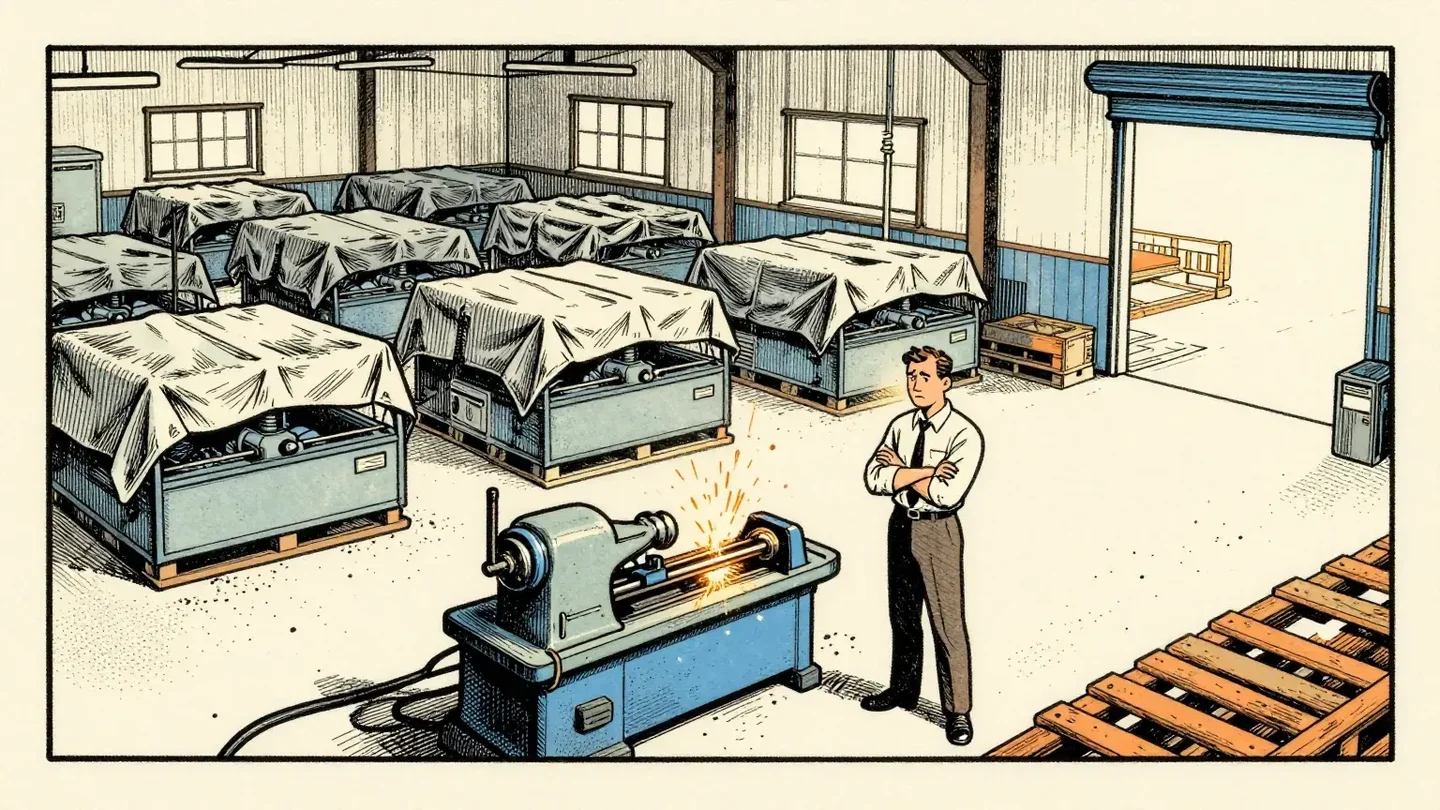
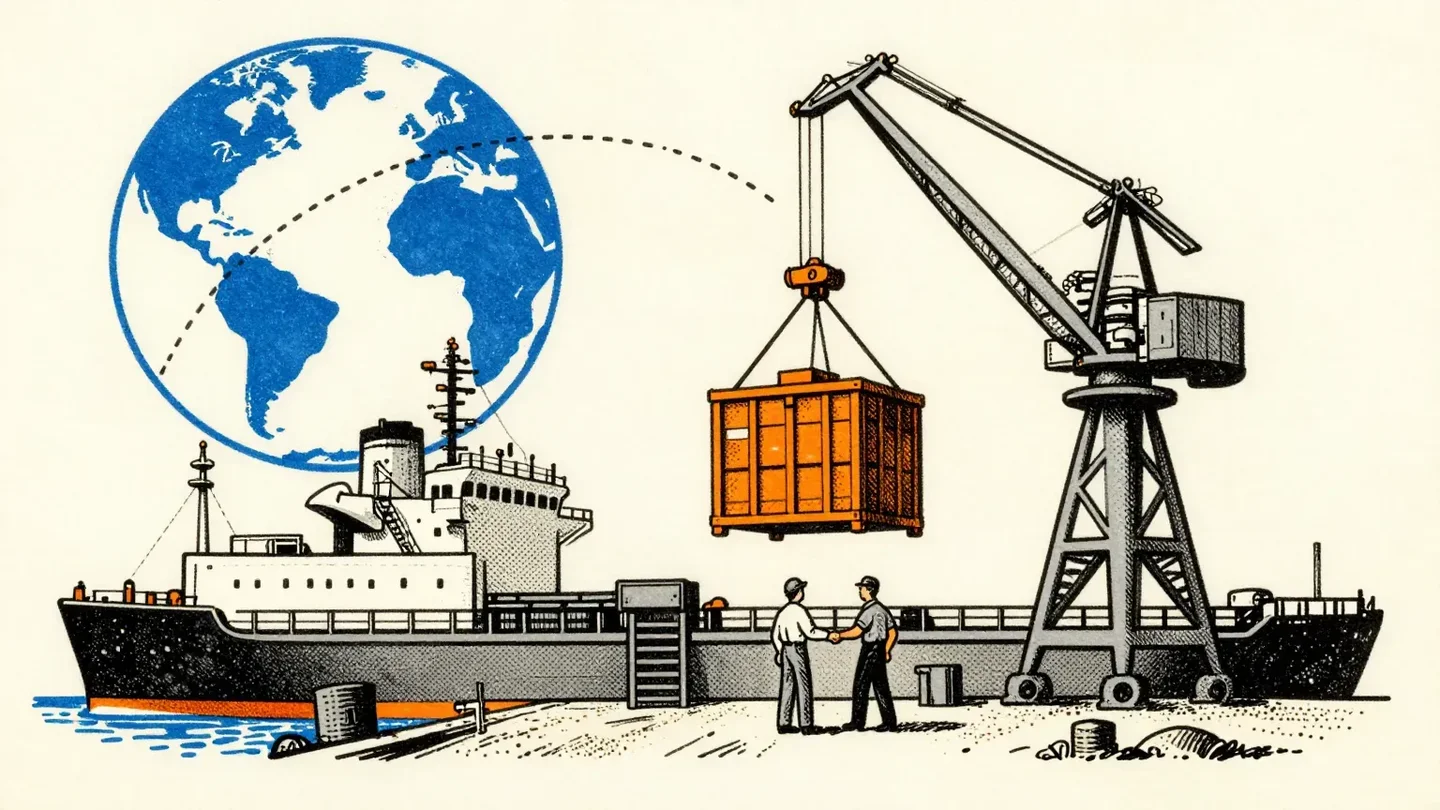
Plenty of machinery manufacturers build equipment that could compete anywhere and still sell almost everything in two or three countries. It is rarely about price or quality. It is because the foreign buyer cannot find them, cannot read them in their own language or does not trust that service will be there when the machine stops. This guide organizes export marketing into five decisions.
How do machinery manufacturers win buyers in a new export market?
They make sure the foreign buyer can find them, understand them in their own language and trust that service exists in that country. Export marketing comes down to five decisions: choose markets with data, build the website for each country, prove local service, combine trade shows with distributors, and be present where buyers research, including AI assistants.
What does the machinery export market look like right now?
Large, and under pressure in the markets that used to be easy:
- Germany. German machinery exports totaled 198.5 billion euros in 2025, down 1.8% nominal and 3.3% after inflation. The EU took 44.7% of them. Exports to the United States fell 8.0% and to China 8.2%, according to VDMA figures reported by Produktion (February 23, 2026).
- Spain. Spain exported about 28 billion euros of machinery in 2024, up 3.3%, with France and Germany as its top destinations and the United States third. In machine tools, about 75% of output is exported (Germany Trade & Invest, August 2025).
The lesson for any machinery maker, American or European: relying on one or two familiar export markets works until those markets buy less. When a top destination shrinks, the companies that already built visibility elsewhere keep their plants busy.
Why do good manufacturers fail to sell abroad?
Four reasons come up again and again.
1. The foreign buyer cannot find them
A procurement engineer in Lyon, Stuttgart or Monterrey searches in their own language, using the technical terms of their country. If your website exists only in English, or in a machine-translated version nobody reviewed, you do not show up. To that buyer, your company does not exist.
2. They find you but cannot use what they find
A literal translation is not enough. Buyers expect their units, their standards, their applications and their references. A spec sheet in inches with US electrical certifications can be perfect for a buyer in Ohio and incomplete for a buyer in Germany who needs CE marking and metric data.
3. They doubt your after-sales service
A machine down on another continent is the buyer's worst case, and that fear outweighs price. If your website does not say who installs, who repairs, how fast and where the spare parts are, the buyer assumes the worst.
4. You are missing where buyers do their research
Gartner surveyed 645 B2B buyers and found they use an average of seven information sources per purchase and that 45% have used generative AI to research vendors and products (Gartner, May 2026). An AI assistant answering in German or Spanish builds its answer from what is published in that language. If nothing of yours exists there, it recommends someone else.
How do you choose an export market?
With data, not with the contact you met at the last trade show. Four questions frame the decision:
- Where are you already selling? Orders that arrived without sales effort point to demand nobody is serving.
- Who is searching for what you make? Search volume for your technical terms by country, in the local language, is a cheap and honest measure of demand.
- Who do you compete against there? Check which manufacturers rank at the top and which ones AI assistants name when you ask about your category in that country.
- Can you service it? If you cannot install and repair within a reasonable time, with your own technicians or a local partner, that market is not ready for you yet, however strong demand looks.
Pick one or two new markets and work them properly. Ten countries at once with a machine-translated website is not exporting. It is being on the map with nobody visiting.
What has to change on your website to export?
Your website is your sales office in every country where you have no office. For it to work:
- One version per language and market, written for that buyer, with their technical terms, units and standards.
- Language tags done right. Each version should reference all the others and be referenced back. If one page points to another that does not point back, search engines may ignore the whole set.
- Local proof. Installations in that country or a similar one, customers you can name with permission, the certifications that market requires.
- Service spelled out. Who installs, who trains operators, who repairs, response times and where spare parts are stocked.
- A contact who answers in the buyer's language and time zone. A form answered three days later in another language undoes everything above.
Trade shows, distributors or direct sales?
All three, each with a different job.
- Trade shows. This is where buyers in that country see the machine running and meet the people behind it. They work best with a target account list and booked meetings, not by waiting at the booth. See trade show marketing ROI for manufacturers.
- Distributors and agents. They give you local presence and service, but they sell what they understand and what is easy to sell. They need material in their language, technical training and cases they can retell.
- Direct sales. It makes sense for high-value equipment and large accounts, as long as a service structure backs it up.
In all three cases, the buyer looks you up online before signing. What they find either confirms or undoes what the distributor told them or what they saw at the show.
What role does AI search play in exporting?
A growing one. When a buyer asks an assistant which manufacturers of a certain machine can serve their country, the assistant answers in their language, using sources in their language. In practice, AI visibility is visibility per market.
To show up you need three things: pages in the buyer's language that answer their questions directly, verifiable data about your machines and your service in that country, and mentions in third-party sources from that market, such as industry associations, trade journals or trade shows. We cover how this works in how to get ChatGPT and Google AI to cite your company and in how industrial buyers use AI to find suppliers.
Which mistakes should you avoid?
- Running the whole site through a translation tool and calling it done. Buyers notice within two lines that nobody from their country reviewed it.
- Declaring languages you do not have. If there is no German version, do not point the German tag at the English page.
- Leaving everything to the distributor. If the distributor switches brands, you lose the market and the customer data with it.
- Measuring exports only by orders. Orders arrive at the end of a long cycle. To know whether you are on track sooner, you need leading indicators.
How do you know your export marketing is working?
With four signals per market, read together every month:
- Visibility in the local language: impressions and rankings in that country's search results for your technical terms.
- Presence in AI answers when someone asks about your category in that language, logged with dates because answers change.
- Branded searches from that country. If they grow, someone there is recommending you.
- Inquiries and opportunities from that country in your CRM, with their source.
None of the four means much alone. When they rise together, the market is opening.
Related questions
Which country is best for a first machinery export push? The one that combines measurable demand for your technical terms, competition you can beat and a real ability to provide service. For a US manufacturer, neighbors such as Canada or Mexico are natural candidates to test against those criteria; for a Spanish one, the data already points to France, Germany and the United States.
Is an English website enough to export? In some technical niches it opens the door, but German, French or Mexican buyers search and decide in their own language. English does not replace a local version in priority markets.
Do you need your own office in the target country? Not at first. You need verifiable service, either with traveling technicians or a local partner, and you need to explain it clearly on your website.
How long does export marketing take to work? As long as your sales cycle in that market, plus the time to build visibility in its language. Leading indicators move before orders do.
The short version
German machinery exports fell 1.8% to 198.5 billion euros in 2025, with US sales down 8.0% (VDMA), while Spain exported about 28 billion euros of machinery in 2024 and sells about 75% of its machine tool output abroad (GTAI, UN Comtrade). Foreign buyers consult seven sources per purchase and nearly half already use generative AI to research vendors (Gartner, 2026). Exporting with a method means choosing markets with demand and service data, building a website for each country, proving local service, combining trade shows and distributors, and measuring visibility per market before orders arrive.
If you want to see what a foreign buyer, or an AI assistant, finds when it searches for what you make, you can run the automated scan of your website.