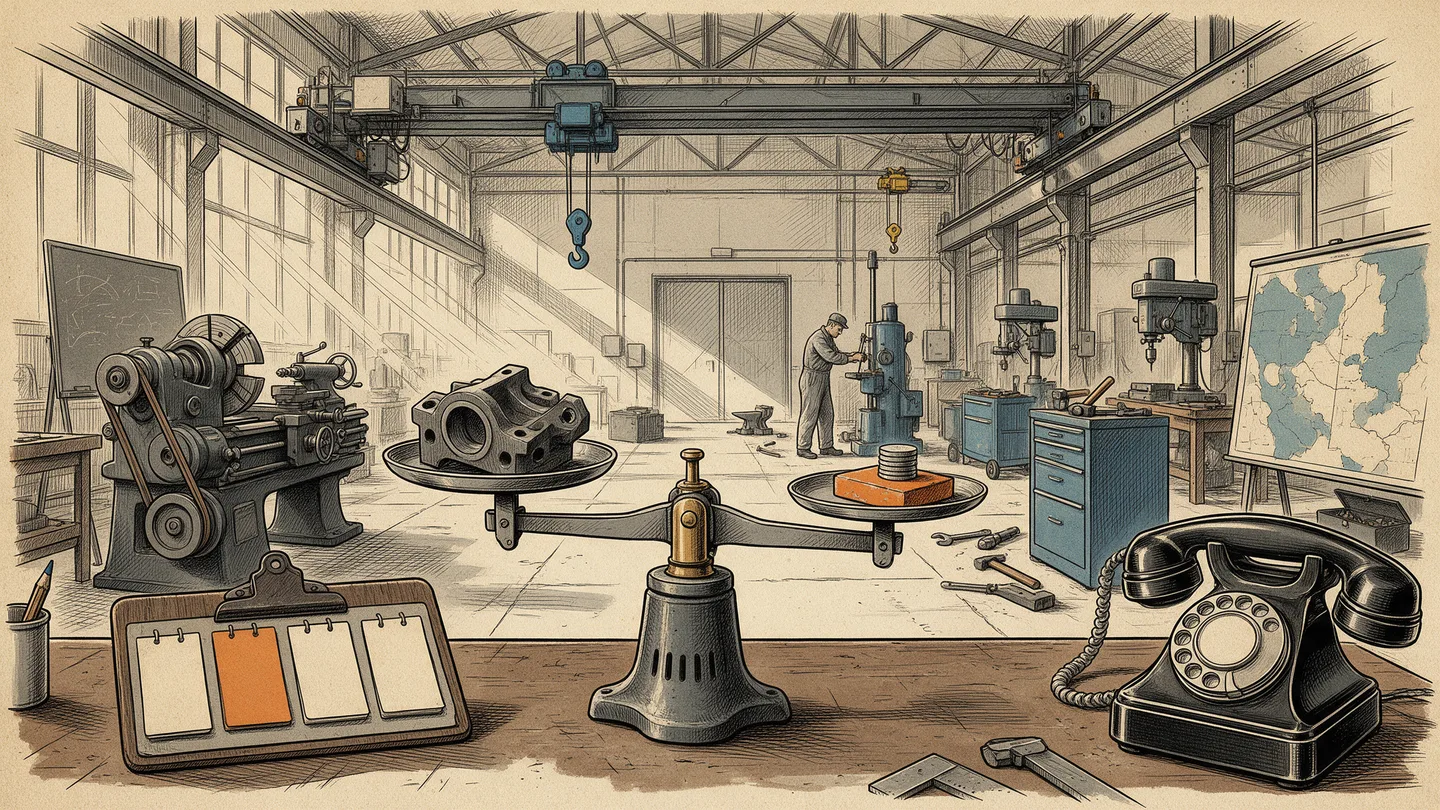
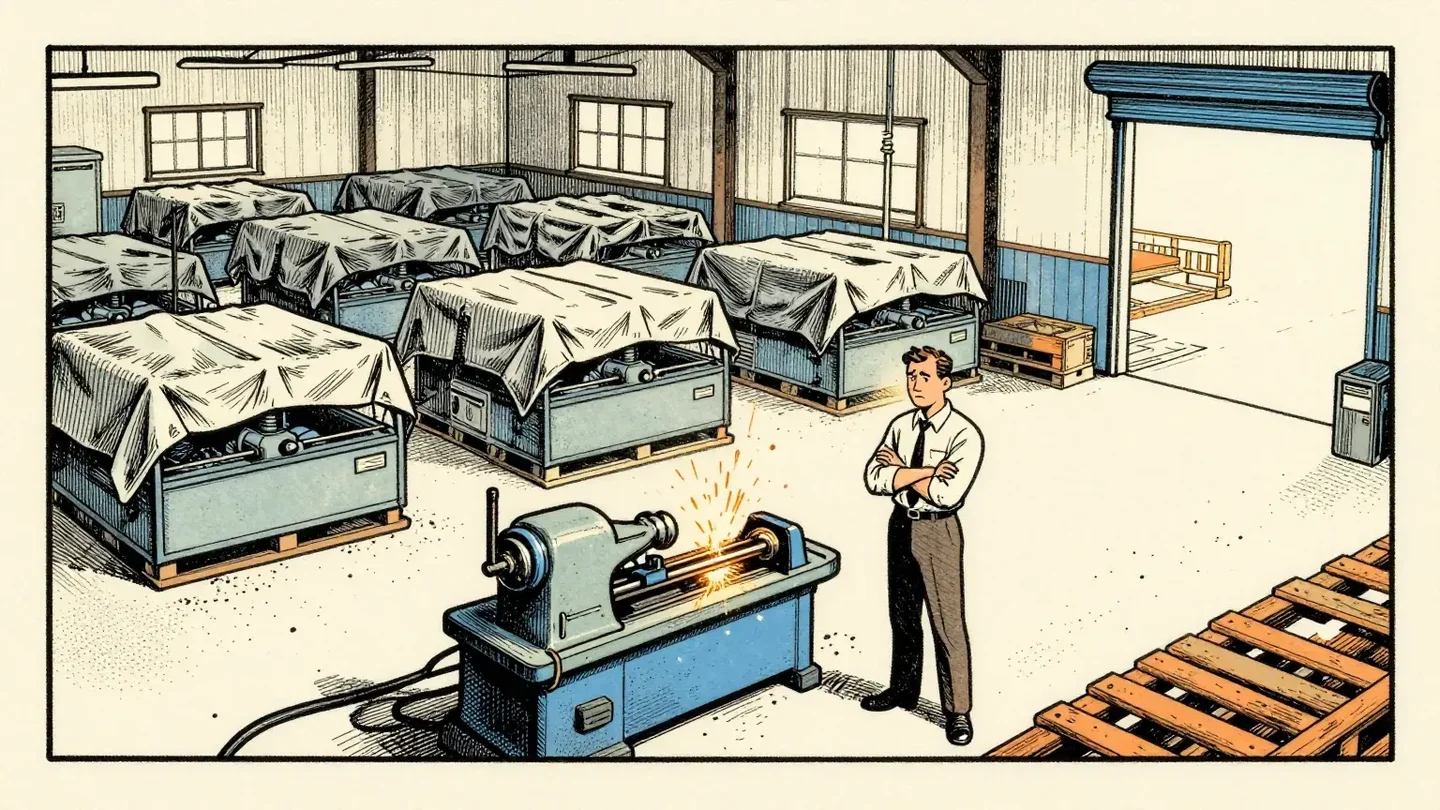
A plant does not run out of work the day a machine goes quiet. It runs out six to twelve months earlier, while the sales team was busy serving current orders and nobody was building the next ones. This guide covers what to measure, where to find new work and which shortcuts turn an open slot on the schedule into a margin problem.
How do you fill idle manufacturing capacity?
You fill idle capacity by building a backlog that does not depend on a few customers or on last month's sales. In practice that means three things: measure the backlog in weeks of production, spread risk across industries and accounts, and generate demand months ahead, because only about 5% of buyers are actively buying at any given moment.
What does "production load" actually mean?
Production load is the committed work a plant has for the coming weeks: firm purchase orders, blanket orders with forecast releases and awarded projects. It is not the same as revenue. A company can have a strong quarter on the books and an empty schedule for the next one.
So the useful question is not "how much did we ship?" but "how many weeks of committed work do we have for each line or work center?" That number, reviewed monthly, is the plant's leading indicator. When it drops, the problem can still be fixed. When it shows up on the income statement, it is already late.
How much manufacturing capacity is sitting idle right now?
More than most plant owners assume. The latest public data shows factories running below their usual levels in the markets we watch most closely:
- United States. The Federal Reserve put manufacturing capacity utilization at 76.0% in July 2026, 2.2 percentage points below its 1972 to 2025 average (Federal Reserve, G.17 release). The September release showed 75.7% for August (G.17, table 12).
- Germany. The ifo Institute measured industrial utilization at 77.5% in January 2026, below its long-term average of 83.2% (Börsen-Zeitung, February 10, 2026). German machinery orders fell 5% in real terms year over year in August 2026, with foreign orders down 6% (Börsen-Zeitung, October 5, 2026).
- Spain. Manufacturing used 78.0% of capacity in the third quarter of 2026, down from 80.1% in the first quarter (OECD survey series via FRED).
For an American job shop or contract manufacturer, this means two things. Your competitors also have open capacity and are chasing the same work. And the OEMs you supply are buying more carefully. Work that used to arrive on its own through the supply chain now has to be found.
Why does a plant run out of work even with good customers?
Four reasons, which rarely show up together in one report.
1. Customer concentration
If two or three customers fill most of the schedule, your load depends on decisions you do not control: a model changeover, a reshoring or offshoring move, an inventory correction. A customer does not have to leave to empty your plant. Buying half as much for two quarters is enough.
2. The lag between selling and producing
In industrial markets, months pass between the first conversation and the first purchase order. If sales effort ramps up only when the backlog is already thin, the new work arrives late, after the plant has already absorbed the gap with idle hours.
3. 95% of buyers are not buying today
John Dawes of the Ehrenberg-Bass Institute estimates that only about 5% of B2B buyers are in market at any given time (Marketing Week). The article's example makes the point: if companies switch business banks about once every five years, only around 2% are shopping for a bank in any given month. A one-month campaign mostly talks to people who will not buy now. What works is staying in a buyer's memory until their situation changes.
4. Buyers do their research without you
Gartner surveyed 645 B2B buyers and found they use an average of seven information sources in a purchase, 45% have used generative AI to research vendors and products, and 67% prefer a buying experience without a sales rep (Gartner, May 2026). If your plant is missing from those sources, the buyer builds a shortlist without you, even when you have exactly the capacity they need.
How do you secure production load, step by step?
These are the steps in the order that works best. None of them requires a new product.
1. Measure the backlog in weeks and by customer
Keep one simple table, updated monthly: weeks of committed work per line or work center, and the share of load each customer represents. That tells you two things the balance sheet does not: when the plant runs dry and who it depends on.
2. Set a concentration limit
Decide internally how much of the load a single customer may represent (for example, a quarter) and treat any breach as a risk. This is not an industry rule. It is a management decision that forces the search for new work before you need it.
3. Map adjacent industries
Your capabilities serve more industries than you sell to today. A machine shop that works for automotive has tolerances, materials and certifications that also matter to rail, energy, agricultural equipment or medical devices. List the industries that buy what you already know how to make, with their quality requirements and their buying cycles, and pick two to start.
4. Build the backlog six to twelve months ahead
If the sales cycle is long, next summer's load is worked on this fall. That means a list of target accounts in those industries, with names, plants and people, and steady contact over time rather than a campaign that stops after four weeks. Our lead generation playbook for manufacturers covers how to turn that into a repeatable pipeline.
5. Be findable when the buyer is searching
If buyers research alone across seven sources, your plant needs to be present in them with information that lets them shortlist or rule you out without calling: capabilities, part size ranges, materials, tolerances, certifications, typical lead times and industries already served. A website that says "quality, service and experience" gives them nothing to decide with. More and more of that research also runs through AI assistants. We explain how that works in how to get ChatGPT and Google AI to cite your company.
6. Use trade shows to open industries, not only to see existing customers
A show in an adjacent industry is the fastest way to learn its requirements and meet its buyers. Go with a target account list and booked meetings rather than waiting at the booth. More on that in trade show marketing ROI for manufacturers.
7. Teach sales to sell capacity, not just products
Many industrial sales teams know how to sell the flagship product and do not know how to offer open plant capacity as a solution. Give them a short pitch per industry: what problem we solve, with what equipment, in what lead time and with what proof.
What does not work to fill a plant?
Three shortcuts look reasonable and usually cost more than they save.
- Cutting price to fill gaps. An order below full cost keeps the machine busy and erodes margin, and it sets a price reference that is hard to raise later. If you must do it, put an end date on it in writing.
- Short campaigns once the backlog is already empty. They arrive late because of the sales-to-production lag. Sales effort has to be steady, not a fire drill.
- Waiting for the RFQ. By the time a buyer issues a request for quote, they usually have a shortlist. If you were not on it, you compete on price alone.
How do you know it is working?
With four signals read together every month:
- Weeks of committed backlog per line. This is the number that matters most.
- Top customer's share of total load. It should fall as work from new industries comes in.
- Open opportunities in the new industries, with company names and expected decision dates.
- Branded searches and inbound requests you did not chase. If they grow, someone is talking about you where you are not.
An improvement in only one of these proves nothing. If they rise together for several months, the plant is building load in a sustainable way.
Related questions
What capacity utilization rate is normal? It depends on industry and country. As a reference, US manufacturing has averaged about 78% since 1972 according to the Federal Reserve, and German industry 83.2% according to ifo. Compare yourself with your own history before comparing with the average.
How far ahead should you look for new work? At least as far as your sales cycle. If a new customer takes nine months from first visit to first PO, the work you need nine months from now is built today.
Should you take small orders to fill the plant? Yes, if they cover full cost and open an industry or an account with potential. No, if they only fill hours and push out better orders.
Does digital marketing work for a contract manufacturer? It works if it answers what a technical buyer needs to build a shortlist: capabilities, tolerances, materials and proof. A PDF brochure does not do that job.
The short version
Production load is lost months before the machine stops. In July 2026 US manufacturing ran at 76.0% of capacity, 2.2 points below its long-run average (Federal Reserve); German industry was at 77.5% in January against an 83.2% average (ifo), and Spanish manufacturing at 78.0% in the third quarter (OECD). With only about 5% of buyers in market at any moment (Ehrenberg-Bass) and seven sources consulted per purchase (Gartner), securing load means measuring backlog in weeks, limiting dependence on a few customers, opening adjacent industries ahead of time and being present where buyers do their research.
If you want to see what a buyer, or an AI assistant, finds when it searches for the capacity your plant offers, you can run the automated scan of your website.